What Are the Limitations of WhatsApp Business API?
Jun 29, 2026

TL;DR
WhatsApp Business API is one of the most effective communication tools for businesses in 2026, yet it doesn't allow for indefinite communication. Businesses must follow the strict rules regarding customer opt-ins, approved templates, limits on messaging and the 24-hour customer support window, the pricing policy, as well as the platform policy. Being aware of these rules before the implementation process can help save both time and money, as well as hassles with compliance.
Imagine that WhatsApp Business API lets you contact anyone, anytime? But it's not exactly.
Although the WhatsApp Business API is a powerful messaging tool, it comes with some important restrictions, including message limits, opt-in rules, template approvals, price rules, and the 24-hour window for messaging. Being aware of these limitations will make it easier to avoid costly errors and get the most out of the platform.
This content will cover the main issues that every company should be aware of in 2026.
The Short Answer: What Are the Main Limitations of WhatsApp API?
The major limitations of the WhatsApp Business API are messaging limits, template approvals and the 24-hour customer support window, opt-in requirements, API rates, as well as strict restrictions on business policies.
Here are the top limitations that businesses must be aware of:
-
It is not possible to send cold messages to users without their consent.
-
Corporate-initiated messages must use approved templates.
-
Free-form discussions are limited to a 24-hour reply time.
-
Capacity for messaging depends on the quality of service and its performance.
-
WhatsApp API is not completely cost-free.
-
Certain industries and business designs are restricted.
-
A poor customer experience can limit the capabilities of your message.
-
Automation still requires human escalation in many situations.
Simple to understand, the WhatsApp API for business is built for permission-based communication, not mass communication.
WhatsApp Business API Messaging Limits
One of the biggest myths is that businesses have unlimited messaging capabilities from day one. However, WhatsApp controls messaging volume through account quality control and messaging limits.
Messaging limits determine how many unique users your business can message within a rolling 24-hour period. Factors such as account verification, quality rating, customer engagement, and complaint rates influence these limits.
| Limit Type | What It Means | Business Impact | How to Manage It |
|---|---|---|---|
| Unique Customer Limits | The number of unique users you can contact | Campaigns are limited in their reach | Scale up gradually |
| Quality Rating | Feedback from users affects the health of your account | Poor ratings reduce capacity | Be sure to send the appropriate messages |
| Tier Upgrades | Greater trust boosts messaging capacity | Greater reach with the span of | Maintain good engagement |
| Rolling 24-Hour Window | Limits are constantly measured | Campaign planning is required. | Monitor sending schedules |
| Campaign Pacing | A large campaign could be planned and paced | Delayed delivery possible | Stagger campaigns |
Businesses need to avoid sending unnecessary advertisements or broadcasts that are too frequent. The gradual increase in volume of messages helps create a positive reputation for the sending company.
The 24-Hour Customer Service Window Limitation
One of the most crucial WhatsApp API for business guidelines is the 24/7 customer service period.
If a client sends an inquiry to your business, and you respond, it marketing campaign opens the 24-hour conversation window. Then, businesses can send out personalized messages without needing to use approved templates.
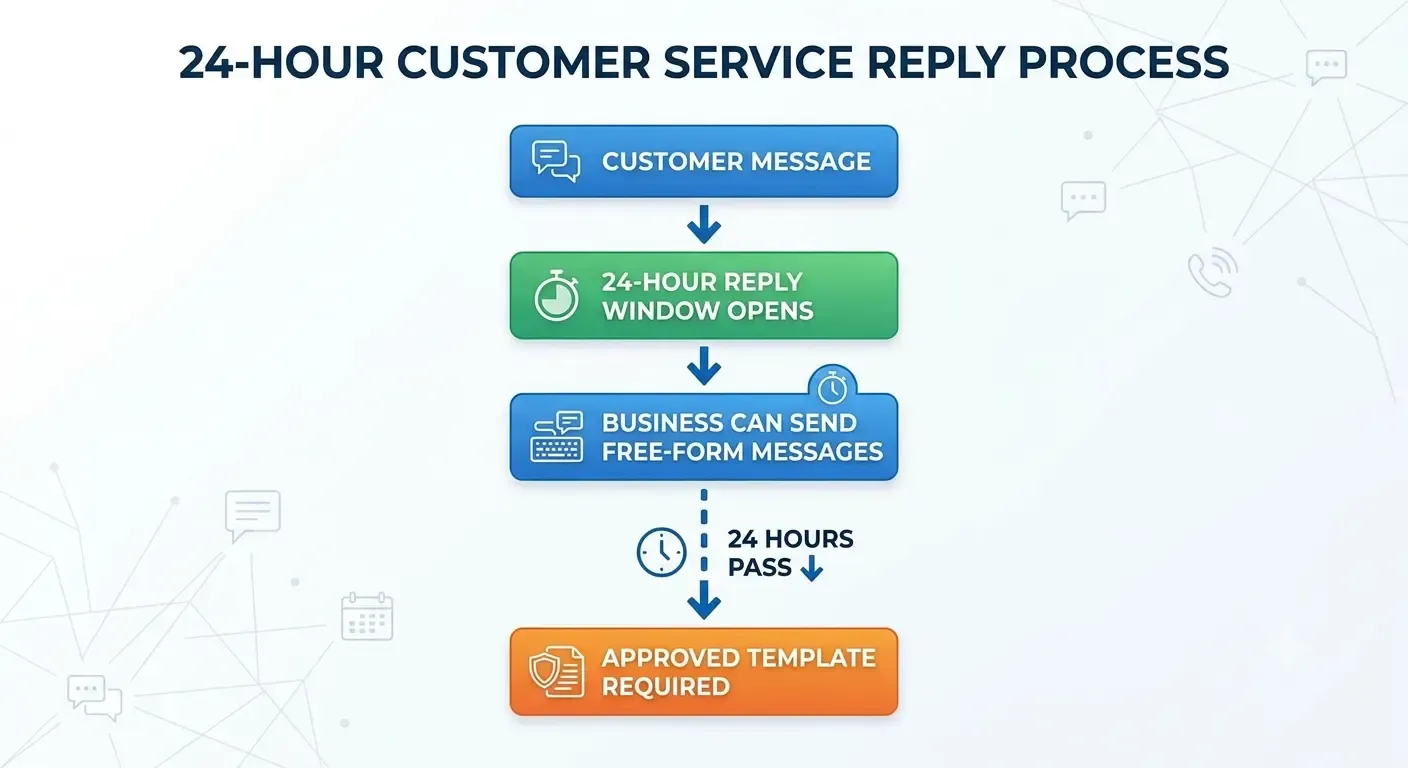
The WhatsApp API 24-hour rule can affect:
-
Support for customers
-
Sales follow-ups
-
Lead nurturing campaigns
-
The messages of cart recovery for abandoned carts
If the client fails to respond within 24 hours, the business must send an approved template to take over communications.
Whatsapp API Template Message Approval Limitations
WhatsApp will require businesses to utilize approved templates to facilitate business-related messaging.
It is not possible to design a marketing campaign and mail it immediately. The templates must undergo the process of review before being used.
Templates may include:
-
Approved
-
Rejected
-
Paused
-
Disabled
This review process can slow down campaign launches if not planned properly.
| Message Scenario | Template Needed? | Why |
|---|---|---|
| The customer asks questions, and you answer within 24 hours | No | Window for active conversation |
| Order update after 24 hours | Yes | A message for the business that is initiated by the company |
| A promotional campaign | Yes | Marketing communications |
| Reminder of appointment | Yes | Notification message |
| OTP/Login Code | Yes | Template for Authentication |
The templates must be compatible with their function and the category. Misuse of templates could lead to refusals or limitations.
Whatsapp API Pricing and Cost Limitations
Numerous businesses seek out keywords such as "whatsapp api free", hoping to use the platform for free. However, this isn't the situation.
Although WhatsApp offers a powerful and efficient messaging system,but the WhatsApp Business API is not entirely free.
Companies may be liable for costs arising from:
-
Charges for meta messaging
-
Platform fees or BSP cost of subscription
-
Costs of integration and development
-
Campaign management expenses
The more outbound messages a business sends, the higher the potential cost.
Common Cost Factors
| Cost Area | Limitation |
|---|---|
| Meta Charges | The cost of usage is based on the amount consumed. |
| BSP/Platform Fees | A few providers offer a monthly fee. |
| Campaign Volume | The cost of more messages is higher. |
| Development Costs | To set up APIs, it is necessary to have access to technical resources |
| Support & Maintenance | Ongoing management expenses |
In the case of companies that run massive marketing campaigns, WhatsApp API costs can be a significant operating expense.
Whatsapp API Automation Limitations
A lot of companies are expecting the WhatsApp API to completely automate the process of communicating with customers.
Although automation can be powerful, it comes with limitations.
Chatbots could:
-
Answer FAQs
-
Conversations on the route
-
Collect information
-
Take care of simple requests
But they frequently struggle with
-
Complex support issues
-
Emotional conversation
-
High-value sales discussions
-
Exception handling
Many successful automation implementations blend automation for human service agents to improve customer service.
When WhatsApp API Is Not the Right Choice?
WhatsApp API is not suitable for every company.
This may be a bad idea in the following situations:
-
All you require is basic one-to-1 messages.
-
You do not have a customer opt-in method.
-
You are planning to launch cold-mailing campaigns.
-
You expect unlimited free bulk messaging.
-
Your business falls into one of the restricted classes.
-
You lack technical resources or provider support.
-
Your team is not able to manage template requirements and conformity standards.
In these instances, the basic WhatsApp Business App may be the best option.
Final Thoughts
Official WhatsApp Business API can be an extremely effective tool to improve customers' communication, automation and interaction. But its success is contingent on understanding WhatsApp's limitations before implementation.
The limits on messages, customer opt-ins and template approvals, the 24-hour service window, quality ratings, limitations on automation, and all play a major role in how the platform operates.
Organizations that know and stay in accordance with these guidelines can create powerful WhatsApp communication strategies while avoiding compliance issues and account restrictions.
Do you need help with installing WhatsApp API without templates and compliance or message-limit problems? Contact our WhatsApp API experts, and we'll guide you to the ideal setting for your organization.
Frequently Asked Questions
Can I send unlimited messages using WhatsApp API?
No. WhatsApp applies messaging limits based on account quality, verification status, and sending history. Businesses must build trust and maintain healthy engagement to increase messaging capacity.
What's the WhatsApp API 24-hour rule?
The 24-hour rule allows businesses to send free-form responses within 24 hours after a customer message. Once the window closes, approved templates are required to continue the conversation.
Do all WhatsApp API messages need template approval?
No, Messages sent in an active 24-hour customer chat are not required to be templates. Business-related messages that are not initiated during this time generally require approved templates.
Can I send promotional messages on WhatsApp API?
Yes, messages for promotional purposes can be distributed using approved templates for marketing, but only to those who have given their consent.
Is WhatsApp Business API free?
No. WhatsApp Business API is not 100% cost-free. Companies may be required to pay Meta fees for messaging, BSP fees, development charges, and platform subscription fees, depending on their setup.
What happens if my WhatsApp API quality rating drops?
A declining quality rating can reduce messaging limits and trigger account reviews. Consistently poor performance may lead to restrictions or suspension.
Tentang penulis

Saifullah Alam
Founder & CEO, WAWCD
Serial entrepreneur and tech founder from Lahore, Pakistan. Started his first businesses while still in university, launched Spadasoft six days after graduating in 2020, and scaled it to a 70-person software company delivering projects across Europe, the USA, and the MENA region. Later founded WAWCD, a WhatsApp marketing platform now trusted by thousands of businesses worldwide with 170,000+ monthly visits and a 4.8-star rating.
You might also like these


WAWCD
AIWAWCD, 91 Donegall Avenue, Belfast, Ireland Utara, BT12 6LS




Hak Cipta © 2026 WAWCD LLC. Semua hak terpelihara. Dikuasakan olehSpadasoft.